

The crash point in Aviator is not invented on the fly while the plane is climbing — it is fixed and hashed before the betting window for a round even opens. Below is a calculation on a conditional example: we break down the Aviator formula step by step on a conditional example so that you can repeat the exact same arithmetic yourself on any real round from your game history.

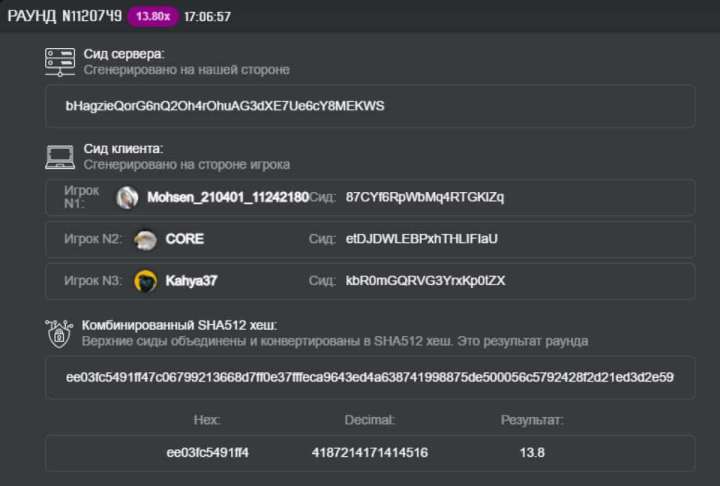
Aviator works on the provably fair protocol: before the betting window opens, the server publishes the SHA-256 hash of the server seed; after the plane has flown away, the server seed and the client seeds of the first three players are combined and hashed with SHA-512, the first 13 hex characters of the digest are read as the number h, and the multiplier is calculated by the formula floor(2⁵² ÷ (2⁵² − h) × 0.97 × 100) ÷ 100 — you can recalculate this manually on any published round. Below the calculation is shown twice. The training seed set gives the first 13 hex ee02c761243b4, the number h 4,187,131,238,040,500, and the multiplier 13.80×; separately captured round #1120749 gives ee03fc5491ff4, h 4,187,214,171,414,516, and the same 13.80×. The arithmetic is identical for any round in your game history.
The meaning of the whole scheme is in the order of actions, not in the hashes themselves. If the server seed were revealed only after the round, nothing would stop the server from retroactively picking a “convenient” seed against already placed bets. Publishing the SHA-256 hash of the seed before the betting window closes this loophole mathematically: the same seed always gives the same hash, and finding another seed with the same hash is computationally impossible. This is called a commit-reveal scheme — “commitment, then reveal”: the server commits to a value it cannot change invisibly, and only reveals it after the outcome can no longer be tailored to player bets.
That is exactly what the whole construction proves — that the crash point was fixed before your bet, not picked after the server saw how much money was at stake. Provably fair is not about whether the game is “profitable” for you — that is a separate story told by the RTP of 97% and the built-in 3% house edge, which no fairness cancels. It is about the particular round not being rigged against you personally.
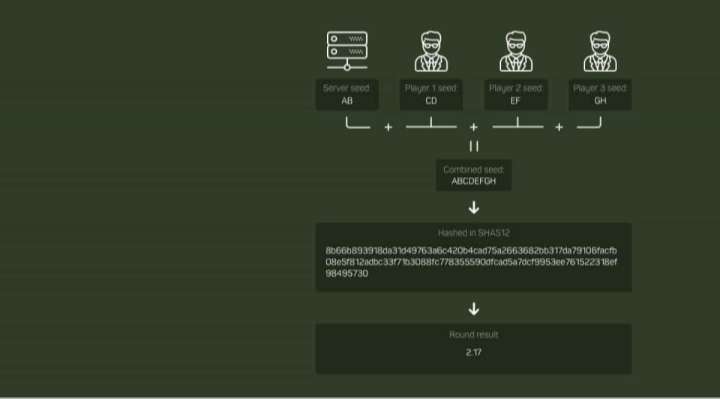
Before the betting window opens, the server generates a random server seed and immediately passes it through SHA-256, publishing the result to players — the hash, not the seed itself. This is the “commitment”: the outcome is already mathematically fixed because it is computationally impossible to swap the seed so that it still produces the published hash.
While the betting window is open, the client seeds of the first three players who placed a bet in that round enter the calculation. This adds entropy from the players’ side, not just the server — a crucial detail that most explanations overlook.
Once the round is over and the plane has flown away, the server publishes the real server seed in plain text. Now anyone has all four values — the server seed and the three client seeds — and can verify both the hash and the final multiplier independently.
The server seed and the three client seeds are combined into a single string and hashed with SHA-512. The first 13 hex characters of the digest are read as the number h, and the multiplier at which the plane crashed is obtained from h using the formula floor(2⁵² ÷ (2⁵² − h) × 0.97 × 100) ÷ 100, where 0.97 is the declared RTP of 97%, built directly into the formula.
The server generates the server seed and publishes its SHA-256 hash. The player sees the hash but not the seed.
The client seeds of the round’s first three players are recorded — entropy comes not only from the server.
The real server seed is published in plain text. From this moment the player has all four values.
SHA-512 of the combined seeds → first 13 hex as the number h → multiplier from the formula. Done independently, without the operator’s involvement.
The formula is open and can be recalculated with any SHA-256/SHA-512 calculator:

The 0.97 in the formula is not a side note — it is a direct reflection of the house edge: the closer h is to the upper bound of the range, the higher the multiplier, but by design the distribution of outcomes is such that low multipliers appear noticeably more often than high ones — hence the convergence to 97% return over the long run. A fair round and a 3% house edge do not contradict each other — that is exactly how it is designed: the formula is public and verifiable, but the casino’s mathematical advantage is not hidden in it; it is written in plain sight.
0.97This is the only place where the game’s economics appear in the formula. Everything else in it is cryptography: hashes, seed concatenation, hex-to-number conversion. The fairness of the round and the house edge live in the same line of code and do not cancel each other out.
Aviator crash point formula, editorial analysis · 11 Aug 2026
On the left is the panel for round #1120749: we captured this round separately, and the readable part of the combined digest begins with ee03fc5491ff4, meaning h = 4,187,214,171,414,516, which gives 13.80×. The seed strings on the screenshot are not fully legible, so we did not guess them.
The table below is a training set of four seeds that you can copy and run yourself: it produces a different digest, ee02c761243b4, yet the same multiplier 13.80×. The “vertical header” on the left and the value on the right make it easier to compare line by line with your own screen.
| Calculation stepParameter | Training seed setValue |
|---|---|
| Server seed | DtpP8vUjdiMfn4dVbJt8bZhsdKT1qAz7iZCwXvZ0Revealed only after the crash |
| Three client seeds for the round | txcgzPAhctu2f4GzBUID · ZPISstqQiNNshsfrm12I · HLfMXKrqj4TOGYla5wcLThe first three players to bet in the round |
| SHA-512, first 13 hex characters | ee02c761243b4 |
| The same number h in decimal | 4 187 131 238 040 500 |
| Calculation | floor(2⁵² ÷ (2⁵² − h) × 0.97 × 100) ÷ 100 |
| Formula result | 13.80× |
These four lines can be copied into any online SHA-512 calculator and will produce exactly ee02c761243b4 — that is what the word “provably” rests on. The procedure is the same as for captured round #1120749 above and for any round in your history: take your seeds after the reveal, run them through the same sequence of steps, and compare the result with what the game showed.
Before placing a bet, copy the server seed hash that the game shows in advance — that is your reference point for verification after the round.
After the crash, the game publishes the real server seed and the three client seeds — usually in the history or “Provably Fair” panel next to the completed round.
Run the revealed server seed through any independent SHA-256 calculator — there are many free online, but it is important not to enter real production seeds on untrusted websites unless absolutely necessary.
The freshly calculated SHA-256 must match character by character the hash published before the round. If it does not match, the seed was swapped retroactively — that is a red flag for the platform.
Combine the server seed and the three client seeds, run them through a SHA-512 calculator, take the first 13 hex characters as the number h, and plug them into the formula above. The result must match the multiplier at which the plane actually crashed in your round — the calculation mechanic is the same as in the worked example above.
The difference is in the moment of time. You can check a past round because after the reveal you hold all four seeds. You cannot predict a future round because before it starts you only have the hash of the server seed — SHA-256 and SHA-512 are irreversible, there is no shortcut from the hash back to the seed — and some of the inputs (other players’ client seeds) are unknown to anyone in advance. Provably fair gives a retroactive proof, not foreknowledge. Why no “predictor” or Telegram bot can ever get around this mathematics is explained in detail on the predictor debunking page.
No, that is incorrect and a frequent mix-up with other crash games. Some platforms on other engines indeed build provably fair on HMAC-SHA-512 with the seed as the key and a nonce counter as the message. Aviator’s construction is different: a plain (non-keyed) SHA-512 of the combined server seed and three client seeds, with no nonce in the multiplier formula. If an article describes Aviator through HMAC and nonce, it either confused it with another game or is simply wrong.
The formula is public and the same for all rounds — the 0.97 is written openly, and it is the declared RTP, not hidden rigging. “Rigged for the casino” refers to an opaque black box that changes depending on the player; here it is exactly the opposite: anyone can take the revealed seeds and get the same result the game showed, regardless of who bet and how much.
Paste the seeds from your casino’s verification panel — we will recalculate the multiplier and show each step.
A commit-reveal cryptographic scheme: the server publishes a SHA-256 hash of the server seed before bets open, and after the crash it reveals the seed itself. Anyone can recalculate the round multiplier using the open formula from the revealed seed and compare it with what the game showed — the step-by-step breakdown is shown in the example above.
Take the revealed server seed and the three client seeds of the round, concatenate them into one string, compute SHA-512 using any independent calculator, take the first 13 hex characters as the number h, and substitute into floor(2⁵² ÷ (2⁵² − h) × 0.97 × 100) ÷ 100. The result must match the multiplier shown by the game.
The server seed is a random value generated by the server and committed with a SHA-256 hash before the round, revealing the seed only after the crash. Client seeds are values tied to the first three players who placed a bet in that round: they add entropy from the player side, not just the server.
To eliminate the possibility of picking a convenient seed after seeing players' bets. Publishing the hash in advance cryptographically "seals" the seed: the later revealed value either matches the already published hash or it doesn't — any substitution is immediately visible.
Faking a specific already-verified round is impossible without it surfacing in the recalculation: the revealed seed either matches the pre-published hash or it doesn't. The round history you see in the interface is the result of past, committed rounds, not something that can be redrawn after the fact without hash mismatches.
No. Aviator's formula is built on regular SHA-256 (for the seed commit) and SHA-512 (for converting the combined seeds into a multiplier), without HMAC or a nonce in the calculation. The HMAC-SHA-512 with nonce construction appears in some other crash games on other engines — a common confusion, but not how Aviator works.
Provably fair checks a round after it has finished and the seed has been revealed — it is proof after the fact. A predictor promises to know the result before the round, when only an irreversible hash is available and other people's client seeds are unknown — mathematically impossible. For a detailed breakdown, see the page debunking predictors.
Reading the formula is one thing, seeing it on a growing multiplier is another. The demo simulator uses exactly this mechanics: SHA-256 commit before the round, seed reveal after the crash, multiplier from the first 13 hex of SHA-512. No money and no registration.
Limitation: the simulator reproduces the formula but is not provably fair in the operator sense — the seeds are generated by your browser, and there is no independent third party. It is an educational demonstration, not a replacement for verifying a real round.

Quick facts: Aviator's RTP is 97% (a Spribe-declared long-run statistical value, not a session promise).
The same mechanics live, without money or registration.
Why predicting the crash point in advance is impossible even in theory.
The betting mathematics on top of the same provably fair mechanics.
Mobile access to Aviator and what to check before installing.
Why Aviator has no reels even though it is often called a slot.
JetX, Lucky Jet, Space XY — whose math is what.

Verifiable rounds are only half the story. The other half is whether your money actually reaches you after a win: that's what we check separately, considering withdrawal times and real player complaints.
Read reviews